The Workload Has a Geography
Could different AI workloads find capacity in places that are already powered, connected and built?

Editorial illustration of northern territories and infrastructure geography.
The next geography of AI may be shaped as much by the kind of work being done as by where the next large data center gets built.
Take Cordova, Alaska. A small computing installation already runs alongside a hydroelectric plant there, and Cordova Electric Cooperative and Greensparc are exploring an expansion into an existing warehouse. What's interesting isn't the size, it's the relationship between the electricity and the computing. Cordova has hydro power that sometimes goes unused, but in winter, lower water flows can push the system back toward diesel.
A conventional data center wants continuous electricity. Some computing workloads, though, can be scheduled, paused, checkpointed, or moved. That opens up a different possibility: computing that follows available energy, instead of asking the energy system to carry an identical load every hour of the year. It also raises a practical question: would the value of the work justify the hardware, connectivity, and operating arrangements needed to use that energy? The pilot shows the physical setup is possible. The commercial answer is still open.
Three locations, three different propositions
In British Columbia, IREN's Mackenzie campus offers another model. It already has electrical infrastructure and physically diverse fiber connections, and the company is expanding its AI infrastructure there. A customer might not need to finance another site at all. It could buy computing capacity instead, provided suitable GPUs and service commitments are available.
In Finland, Glesys runs a data center inside repurposed rock tunnels near Pori. Existing cooling, electrical infrastructure, and telecom connections make it a third route: using a facility that's already fitted out rather than building a new one.
These are three different transactions. Cordova points to flexible computing tied to local energy availability. Mackenzie means buying capacity from an established operator. Pori offers existing physical infrastructure where compatible equipment could be deployed. Their advertised megawatts say very little about which one could deliver a particular workload first.
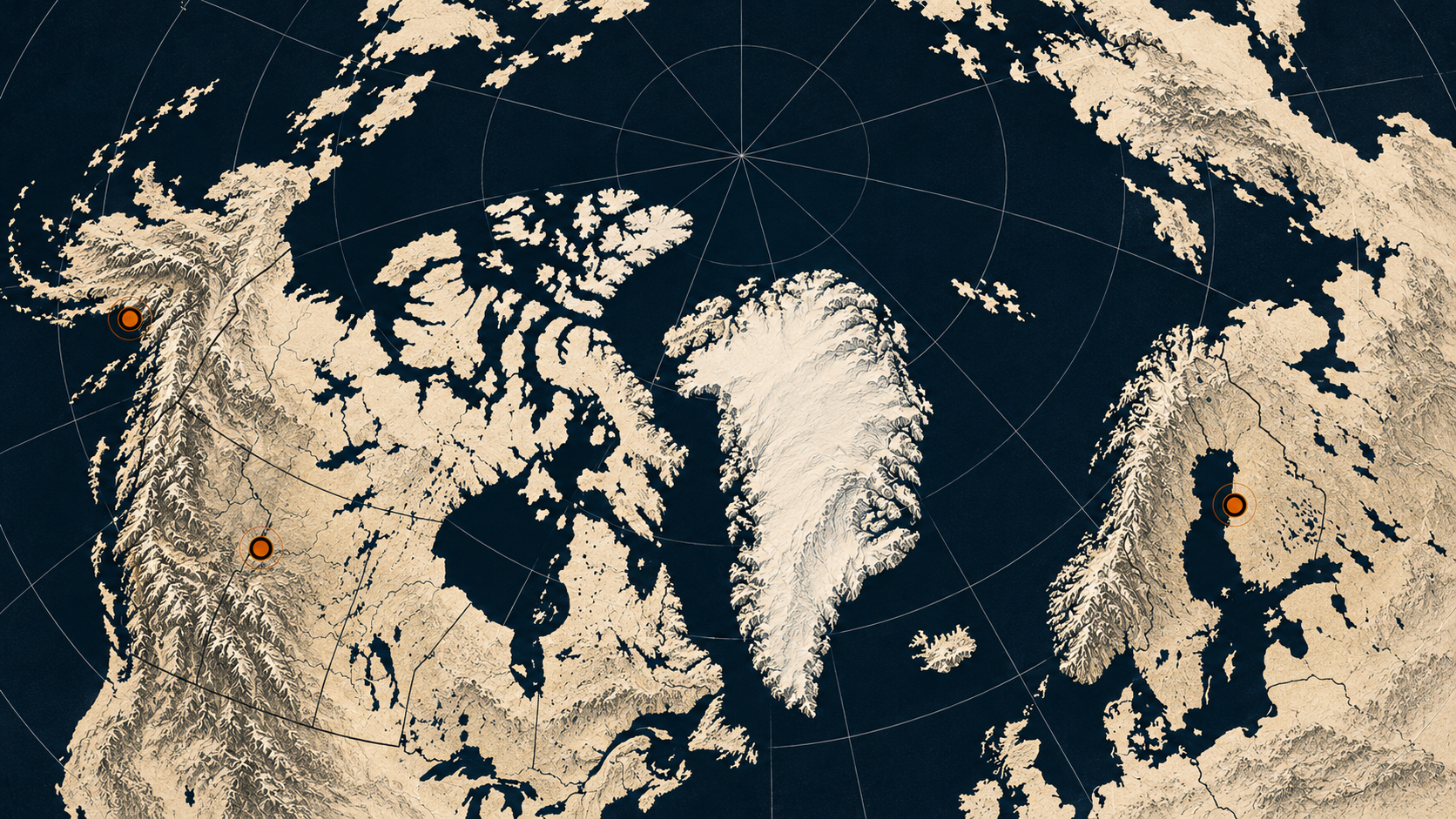
Conceptual geographic illustration. Points are not verified computing sites or confirmed capacity.
What actually needs to move?
The question gets more interesting as large American data-center projects run into political, regulatory, and electrical constraints. A delayed campus can still get built, and its investors may still believe in the location. But the computing work meant for that campus doesn't necessarily have to wait for every building, substation, and transmission upgrade. Some jobs do need enormous, continuously available GPU clusters. Others can tolerate longer transfers, planned interruptions, or running somewhere else entirely.
That distinction could change which places are commercially interesting. A remote hydroelectric utility may never become a hyperscale destination and still offer useful capacity for certain jobs. An existing industrial building may be worth more than an undeveloped campus if it can start operating sooner. And a location with cheap electricity can lose its apparent edge once network costs, diesel backup, equipment delivery, or unreliable service enter the picture.
A different way to compare locations
At Frontier Grid, we're starting with a simple experiment: take the same hypothetical computing workload and compare it across different physical and commercial arrangements. Instead of ranking sites by announced megawatts, we look at when the work could start, how reliably it could run, and what each completed unit of computing would cost.
Cordova, Mackenzie, and Pori are three starting points. None of them has yet shown a specific offer for the same workload, and that's exactly what the comparison needs to establish.
The larger question goes beyond these sites. How much of the future AI workload really needs to follow the geography of the largest data centers, and how much could find its own?