Self-generation is now the law. Someone still has to get paid to build it
Venezuela's electricity reform tells oil operators to power their own fields. The same week, the contractors who would build that power said they hadn't been paid.
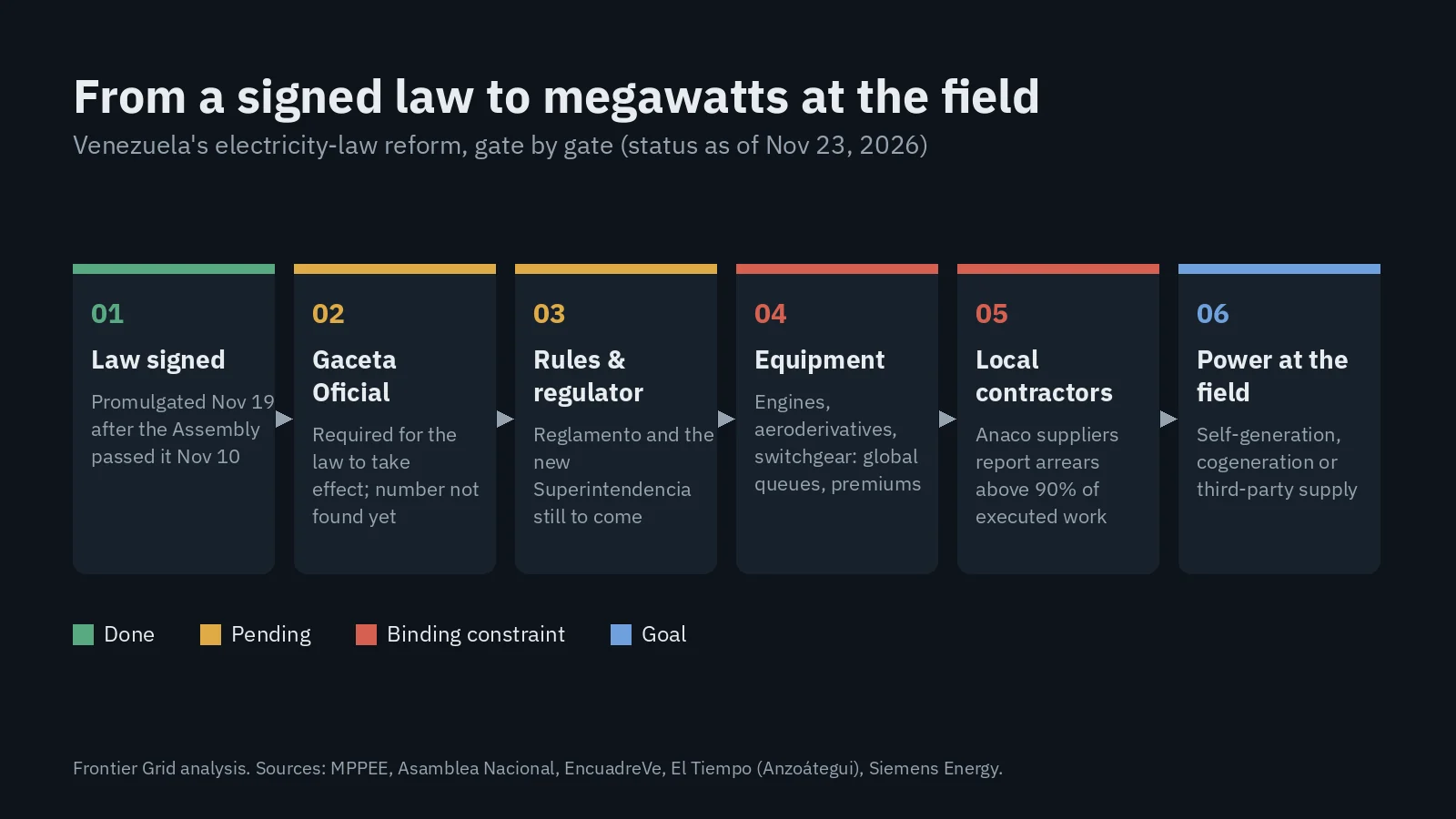
Frontier Grid diagram. Status of each gate as of November 23, 2026.
Venezuela's electricity reform tells oil operators to power their own fields. The same week, the contractors who would build that power said they hadn't been paid.
On November 19, at the opening of an energy expo in Lechería, Anzoátegui, Venezuela's acting president signed the promulgation of the reformed Organic Law of the Electric System and Service. The National Assembly had passed it on November 10. Most coverage focused on the opening: private and mixed companies can now generate electricity under concessions of up to 25 years, with fiscal incentives and a new Superintendencia to regulate the sector.
The article that matters most for the oil recovery is less glamorous. Oil companies must now "ensure and guarantee" a continuous, reliable supply of electricity for their primary activities through self-generation, cogeneration or contracts with third parties. According to the published summaries, they don't need state authorization to produce power for their internal networks unless they connect to the national grid. The government says this only writes into law what was already in the contracts signed with operators this year.
Inland, in Anaco, a different document was circulating that same week. Contractors that supply PDVSA Gas with transport, gas services, maintenance and drilling protested for the second time in November (on the 9th and the 17th) and delivered a letter saying overdue debt exceeds 90% of contracts already executed and approved. They also accused the company of making recognition of old debts conditional on new work.
Put the two side by side and the reform reads differently. The law decides who is responsible for the megawatts. It doesn't decide who gets paid to install them.
What the law actually changed
The obligation to self-generate moves the electricity problem off the national grid and onto each operator's project budget. That is a rational response to a system that, according to independent estimates cited by UPI, is short 2,000 to 2,500 MW a day, and where a September survey found 62.8% of households had daily outages. The state can't promise firm supply to new oil projects, so it makes them bring their own.
A few details shape the opportunity:
- Concessions above 50 MW are granted by the Ministry of Electric Energy, according to EncuadreVe's reading of the text. Field-scale generation for a single block will often sit below that line, which favors modular plant: gas engines, aeroderivative turbines, rental fleets and the switchgear that ties them together.
- The state keeps the backbone. Caroní, Paragua and Caura hydro, the Uribante-Caparo complex, trunk transmission and dispatch stay reserved to the state. Private capital gets the edges of the system, not the core.
- Self-generators can be called on. Article 105, as described by the National Assembly, lets authorities revoke the license of a self-generation plant above 2 MW that refuses to supply power during a state of exception. An asset built to keep a field running could, in an emergency, be asked to help keep a city running.
- Tariffs are indexed to the strongest currency, with subsidies for those who can't pay full price, according to the Assembly's president. That matters for anyone thinking about selling surplus power to large industrial customers.
What hasn't happened yet matters as much. As of November 23, we couldn't find a Gaceta Oficial number publishing the reform. EncuadreVe noted on the 19th that publication is still required for the law to take effect. The reglamento, the incentive details and the Superintendencia's leadership are all still to come. Until then, the obligation exists mostly in contracts and speeches.
The power plant needs a builder, and the builder needs cash
A self-generation obligation is, in practice, an order book: gas conditioning, generators, substations, internal lines, protection systems, controls, then years of operation and maintenance. Some of it will be imported. Much of the installation, civil work, transport and upkeep falls to the same regional contractors that are now protesting in Anaco.
That is the tension. The firms closest to the work are the ones whose balance sheets are most damaged by PDVSA arrears. A contractor that hasn't been paid for executed jobs can't easily finance the inventory, crews and equipment needed to build a 20 MW plant for a new operator, even if that operator pays on time.
There's evidence the market is already splitting in two. On November 17, a group of nearly 200 mostly Venezuelan companies presented Capital Nacional in Caracas: a proposal to audit and certify their receivables from PDVSA and turn them into "mirror claims" that could serve as collateral for credit. One of its promoters said his company had just reached full operating capacity for the first time in more than a decade, thanks to demand from the new operators. So the same firms can be fully booked by new clients and still be starved of working capital by an old one.
For now, Capital Nacional is a creditors' proposal, not a payment plan. Bloomberg Línea notes that OFAC's General License 58 allows advisory and preparatory work on restructuring but not negotiating or executing deals. Certification can start; recognition by the state can't yet.
We've argued before that the payer is part of the infrastructure and that licenses don't pay the bills. The electricity reform is a new version of the same problem. A legal obligation becomes physical capacity only when someone can fund the work and get paid for it.
Equipment is a second queue
Self-generation looks like a way around a weak grid. Globally, it is turning into its own waiting line. Siemens Energy reported 104 GW of gas-turbine commitments at the end of its fiscal year (65 GW of firm backlog and about 39 GW of slot reservations), and its executives expect orders to stay near current levels through 2030 and possibly 2035. Its new North American transformer and switchgear hub is sold out for its first two years.
That pressure comes largely from data centers and utilities in the United States, the same "bring your own generation" logic now showing up in PJM's new large-load proposal and Alberta's Bill 42. Venezuela competes for that equipment from a weaker position: more payment risk, more sanctions compliance and smaller orders. We cover the same pattern for AI campuses in our short answers on on-site power and the power-equipment supply chain.
The practical consequence: in the near term, oilfield self-generation in Venezuela is more likely to come from reciprocating engines, aeroderivatives, used or refurbished units and rental power than from new large-frame turbines. Those options are faster, more expensive per MW and better suited to the scale of a single block.
Where the opportunity sits
If the law takes effect roughly as described, the value shows up in a few specific places:
- Operators with their own commercialization rights. Those that sell their own crude and control the revenue can pay for generation directly. They'll get power first, and they'll pick the suppliers.
- Modular generation and rental fleets. Engines, aeroderivatives, mobile substations and the firms that can deliver them in months rather than years. Contracts that bundle equipment, fuel handling and O&M fit an environment where operators don't want to own power plants.
- Associated gas. Fields that flare or vent gas have a fuel source right next to the load. Gas conditioning and small processing units become part of the power project. In eastern Venezuela, the gas chain and the power chain are the same chain, and Anaco sits in the middle of both.
- Local contractors that can get paid offshore or through dedicated accounts. The firms that work for new operators with clear payment structures, rather than for PDVSA, are positioned to scale. Receivables financing, if Capital Nacional or something like it gets recognized, could unlock the rest.
- Grid-edge services. Protection, controls, metering and interconnection studies for plants that may later be asked, under Article 105, to support the national grid.
Geopolitics: islands of power in a dark grid
The reform has a political side. Lit oilfields next to towns with daily blackouts is a visible contrast, and the state has built itself a lever: in an emergency, private self-generation can be called on. For investors, that is a sovereignty risk that sits inside the asset. For the government, it is a way to share the burden of a failing grid without giving up control of hydro, transmission or dispatch.
It also connects to Washington. The pace of payments, restructuring and equipment imports depends on U.S. licensing. Self-generation lets new production grow without waiting for the national grid, which the Venezuelan government and its partners both want. But every turbine, transformer and controller still passes through a compliance process.
What to watch
- The Gaceta number and final text, especially the self-supply article, the 50 MW threshold and Article 105.
- Whether PDVSA Gas responds to the Anaco contractors' five-business-day deadline (around November 24 by our count) or the claim moves to PDVSA headquarters in Caracas.
- An official mechanism to reconcile and certify receivables, which would make Capital Nacional's proposal financeable.
- The first named self-generation contracts from new operators: who supplies the equipment, who installs it, and how it gets paid.
The law answers the question of who owes the megawatts. The next few months will show whether anyone can afford to build them.
Follow fields, operators and contractors on the Venezuela Activity Map.
Sources
- MPPEE — Promulgation of the electricity-law reform, November 20, 2026
- Asamblea Nacional — Parliament passes the Organic Law of the Electric System and Service, November 10, 2026
- EncuadreVe — What the reform changes; Gaceta still pending, November 19, 2026
- UPI — Venezuela enacts electricity reform to attract private investment, November 20, 2026
- El Tiempo (Anzoátegui) — Contractors again demand payment from PDVSA Gas in Anaco, November 17, 2026
- Bloomberg Línea — PDVSA commercial creditors seek to restructure debts, November 10, 2026
- Bloomberg Línea — "Mirror claims": 200 companies' formula to turn PDVSA debt into financing, November 18, 2026
- Siemens Energy — Q4 FY2026 analyst presentation, November 11, 2026
- Utility Dive — Elevated demand for gas turbines could persist through 2035, November 17, 2026